
The Arm
Le jeu est fait — fragments of a constructed romance

Richard never knew that I didn’t fall in love with him but with the concept he and I co-created.
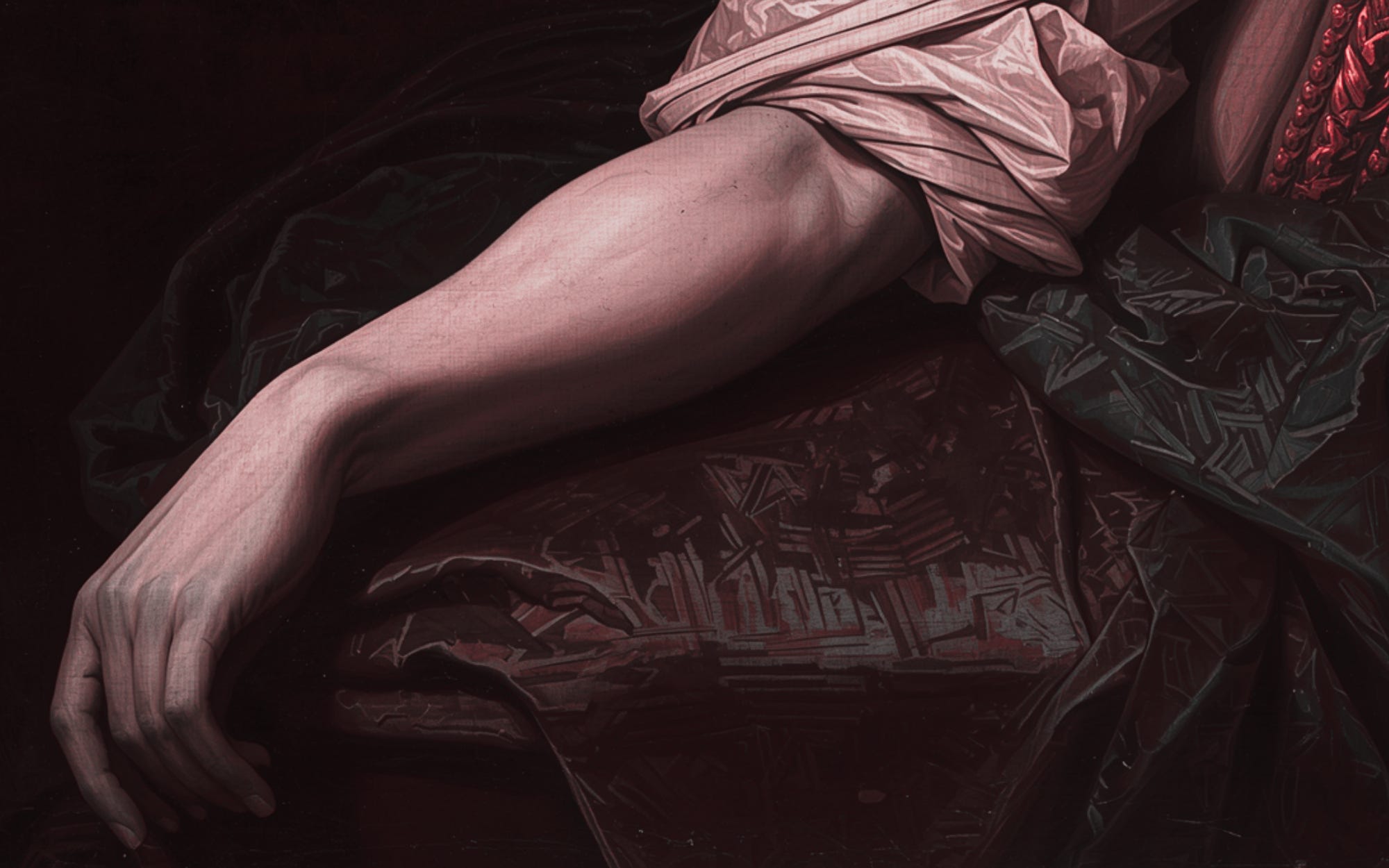
It all began with his arm, his right arm. I was in class and vaguely aware that a boy was sitting to my left. The hazy morning light filtered through the tall classroom windows, catching the fine golden hairs on his right arm where it rested on the little attached desk of one of those miserable wooden college chairs. Thin but very strong looking. A very alive boy’s arm.
Something in that moment shifted, a small internal tilt toward something grand and slightly dangerous. There was something almost indecent about the bones and the skin and the angle.
Then he glanced up at me.
He had huge haunted blue eyes, ringed with such dark shadows he looked either terminally ill or “literary,” which at twenty-one seemed essentially the same thing. The darkness beneath them intensified their electric blue. His head had the quality of a skull with skin stretched just tight enough over it to pass for human in passing light. Closely shaved hair, almost military. Absolutely horrible and also devastating.
I thought, again: romantic dying poet.
Our professor was lecturing enthusiastically about William Blake while The Doors played softly through speakers, creating a slightly deranged, smoke-thin atmosphere. Everyone else looked aggressively Southern Californian in flip-flops, dark tans, white teeth. Richard looked like he had wandered out of a tuberculosis ward in Prague.
At the end of class I tore a page from my notebook and wrote: I must know you.
I left it on his little desk and walked away very upright, shoulder blades back. My Russian ballet teacher Ludmilla had trained me to weaponize posture. I wanted him to notice me leaving and, more than that, to understand it. At that age I believed a girl’s back could communicate elegance, mystery, superiority.
The next class he wasn’t there.
I was furious.
Not hurt. Furious.
I had already constructed an entire mythology around him and now he had simply disappeared into it. I sat through the lecture in a kind of public humiliation while the professor compared Jim Morrison to Rimbaud.
Then Friday morning he returned.
Ninety-eight degrees outside and he arrived wearing black Levi’s, motorcycle boots with square toes, and a leather jacket. Other boys wore shorts and white T-shirts. Richard dressed like a decadent European orphan in exile. The effect was almost ridiculous. Almost.
He took off the jacket slowly and there were the arms again, entirely separate from the gothic catastrophe of his face.
Halfway through class he slid a folded note toward me.
I waited until afterward to open it.
“So you want to play?” it read.
“Be prepared for a dangerous game. Once begun there is no out. Le jeu est fait.”
It was the stupidest and sexiest thing I had ever read.
After that we stopped behaving like ordinary people.
We never spoke in class. We wrote each other constantly instead. His notes arrived folded into impossible geometric shapes, filled with Baudelaire and death rituals and symbolic murder and obscure French references he probably only half understood. Mine became increasingly performative in return. I signed them Zelda for reasons I no longer remember. He addressed me as Zelda even when other people used my real name standing directly beside us. I started eating tomato and mayo sandwiches.
By autumn, we had constructed an entire private mythology without ever having had a normal conversation.
He began leaving letters under the mat outside my apartment in Banker’s Hill. I lived in a crumbling Victorian house with three roommates who treated life as a kind of ongoing off-Broadway production. Two of them were actors, to be fair. One evening my friend Stu found me rereading a seven-page letter Richard had written in cramped, slanted handwriting about destiny, incest, and the symbolic necessity of killing me.
“You know he’s insane,” Stuart said calmly.
“I know,” I said.
“Okay,” he said. “Just making sure.”
The letters grew longer. So did the silences.
One afternoon I asked Richard—in writing—to meet me at the campus cafeteria, which was unfortunate because that’s where the jocks and fraternity boys held court. It smelled permanently of burnt pizza and stale beer. The least romantic place in Southern California.
Seeing him there, outside the elevated atmosphere of the literature department, startled me. He looked older somehow. The dark shadows beneath his eyes had deepened so much he looked almost cadaverous.
We sat across from each other and stared, neither of us prepared for actual speech.
Finally, he said quietly, “I cannot do this.”
I knew exactly what he meant.
Talking would ruin everything. Voices would expose what we were: two literature students performing doom and desire for each other with embarrassing sincerity.
But I wasn’t ready to give it up yet.
“My house,” I said. “Eight o’clock.”
That evening, I lit white candles all over my bedroom and smoked half a joint while waiting for him. When he arrived, I led him upstairs without speaking.
He stood at the foot of my bed looking terrified. Not frightened of me exactly. Frightened of becoming real.
“Zelda,” he said finally. “My sister.”
The line was ludicrously absurd.
Months later, after it had already begun collapsing under the weight of its own invention, I saw him standing outside the literature building in harsh daylight. No shadows. No candlelight. No folded notes like relics.
For the first time I noticed the weakness of his chin.
I realized I never fell in love with Richard. I fell in love with the story we were trying to live inside.
again all i can say is i'm really in this with you. you have this magical talent for capturing the essence of the thing. socal especially, but in general
ahh. your writing oozes risk. it’s rather haunting, and seductive. what a thriller.